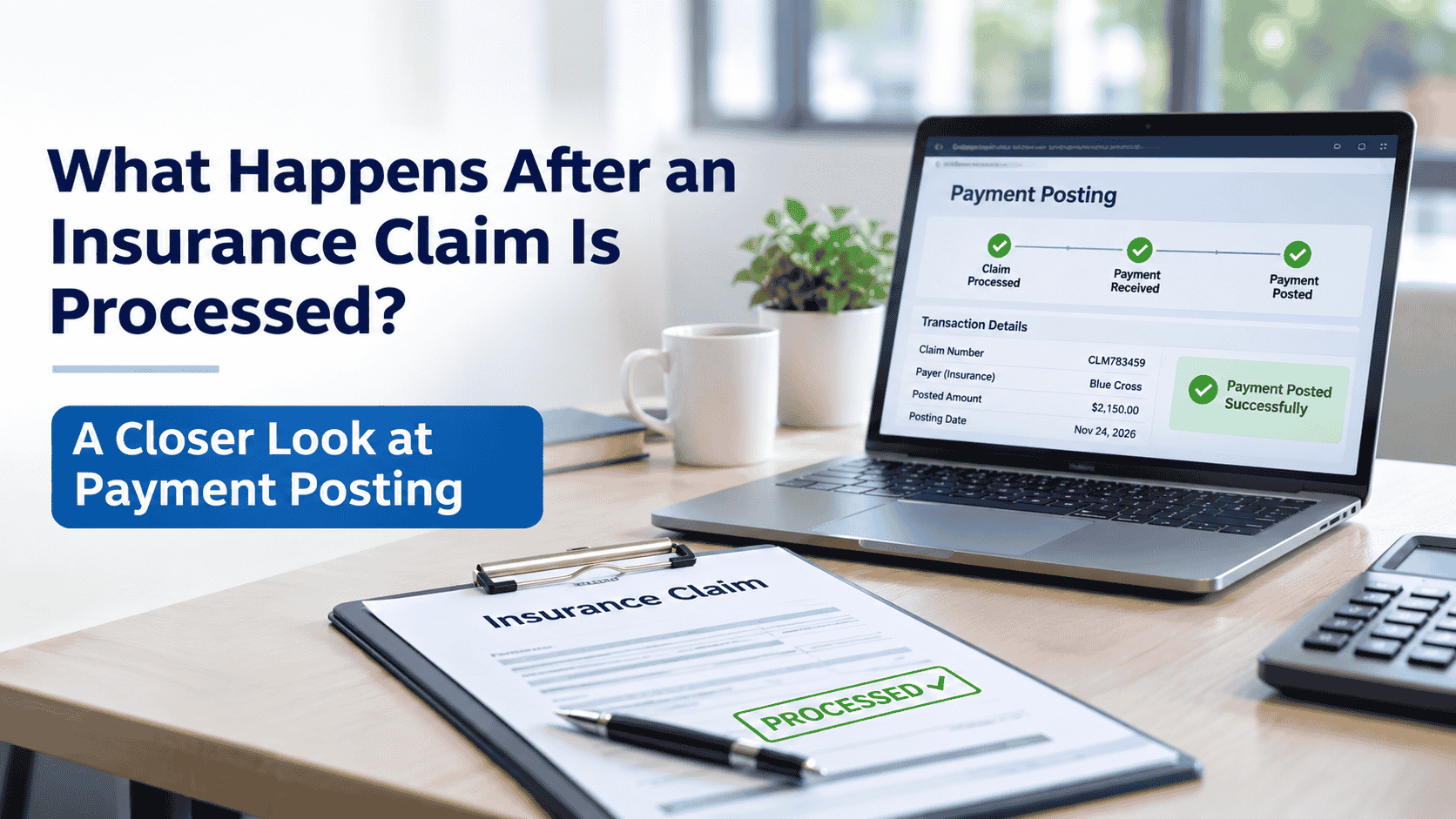
Insurance payment posting is one of the most important activities in the healthcare revenue cycle. Every time an insurance company processes a medical claim, the healthcare provider needs to understand how much was paid, what adjustments were made, and whether any amount remains outstanding.
But payment posting is not simply about entering numbers into a billing system. It involves reviewing insurance remittance information, matching payments with claims, understanding adjustment codes, identifying discrepancies, and making sure patient accounts reflect the correct financial information.
For medical practices, hospitals, specialty clinics, and healthcare billing departments, an accurate payment posting process is essential for maintaining reliable financial records.
Consider a situation. A medical practice submits a claim for $300. The insurance company processes the claim and pays $180. Another $70 is assigned as patient responsibility, while $50 is adjusted according to the provider’s contractual agreement.
If the billing team records only the $180 payment without accounting for the remaining amounts, the patient’s account will not reflect the complete claim outcome.
This is why insurance payment posting requires attention to detail and a clear understanding of insurance reimbursement rules.
In this guide, we will explain how insurance payment posting works, what information is involved, how adjustments are handled, what challenges billing teams encounter, and how healthcare organizations can improve the process.
What Is Insurance Payment Posting in Medical Billing?
Insurance payment posting is the process of recording payments received from health insurance companies against the corresponding patient accounts and medical claims.
After a healthcare provider delivers a service, the billing team submits a claim to the patient’s insurance company. The payer reviews the claim, checks the patient’s coverage, applies its reimbursement policies, and determines the amount payable.
Once the claim is processed, the payer provides payment and remittance information explaining the outcome.
The billing team uses this information to update the patient’s account in the practice management system or electronic health record (EHR).
Insurance payment posting generally involves recording:
- Insurance payments received through electronic transfers or checks.
- Allowed amounts based on payer reimbursement policies.
- Contractual adjustments.
- Deductibles, copayments, and coinsurance.
- Denied or partially paid claim information.
- Outstanding insurance and patient balances.
- Refunds, recoupments, and other payment corrections when applicable.
The objective is to make sure that the financial outcome of every processed claim is accurately reflected in the billing system.
Understanding the Role of Payment Posting in the Healthcare Revenue Cycle
To understand why payment posting matters, it is important to look at the complete healthcare revenue cycle.
Revenue cycle management begins before a patient receives medical care and continues until the financial responsibility associated with the services has been resolved.
A typical healthcare revenue cycle includes:
- Patient registration: Collecting patient demographics, contact details, and insurance information.
- Insurance eligibility verification: Confirming coverage, benefits, and relevant policy details.
- Medical coding: Translating diagnoses, procedures, and services into standardized codes.
- Charge entry: Recording the services provided and their corresponding charges.
- Claim submission: Sending claims to insurance companies for reimbursement.
- Claim adjudication: The insurance company reviews the claim and determines payment.
- Insurance payment posting: Recording payments and adjustments in the billing system.
- Denial management: Investigating claims that were denied or incorrectly processed.
- Accounts receivable follow-up: Following up on unpaid and underpaid claims.
- Patient billing: Managing the remaining patient financial responsibility.
Payment posting connects claim adjudication with the next financial activities.
For example, if a payer approves a claim but assigns part of the balance to the patient’s deductible, the payment posting team records that information. The patient billing team can then use the updated account balance to manage the appropriate patient statement.
Similarly, if the payer denies a service, the denial information can be routed for further investigation.
Without accurate payment posting, subsequent revenue cycle activities may be based on incomplete or incorrect information.
How Does the Insurance Payment Posting Process Work?
The payment posting process involves several stages. Although workflows differ depending on the healthcare organization, billing software, and payer, the following steps represent a typical process.
1. Receiving Insurance Payment Information
The first step is receiving payment information from the insurance company.
Insurance payments can arrive through:
- Electronic Funds Transfer (EFT).
- Paper checks.
- Other payer-approved payment arrangements.
When payments are made electronically, the payer generally sends corresponding remittance information that explains how the claims were processed.
The billing team needs to make sure that the payment information and remittance advice are available before completing the posting process.
2. Reviewing Electronic Remittance Advice (ERA)
An Electronic Remittance Advice (ERA) is an electronic document that explains how an insurance payer processed submitted claims.
It contains detailed information about the payment decision, including:
- Claim identification details.
- Billed charges.
- Allowed amounts.
- Paid amounts.
- Adjustment codes.
- Patient responsibility.
- Denial or remark information.
Most standardized electronic remittance advice transactions use the ASC X12 835 format.
An ERA can contain information about multiple claims and multiple service lines. Therefore, payment posting staff must review the details carefully instead of treating the entire payment as one transaction.
3. Matching the EFT With the ERA
One important part of insurance payment posting is matching the actual payment with the corresponding remittance advice.
For example, an insurance company may deposit $5,000 into a healthcare provider’s bank account while sending the ERA electronically.
The billing team needs to confirm that the payment amount corresponds to the remittance information.
The X12 trace number, also called the TRN or reassociation trace number, helps connect the EFT with its corresponding ERA.
This process is known as EFT and ERA reassociation.
If the payment and remittance information do not match, the billing team may need to investigate before posting the transaction.
4. Matching Claims With Patient Accounts
After reviewing the remittance advice, the payment posting team identifies the corresponding claims in the billing system.
Important information may include:
- Patient name and identification number.
- Claim number.
- Date of service.
- Provider information.
- Procedure codes.
- Billed amount.
The objective is to make sure that the payment is applied to the correct patient and claim.
Posting a payment to the wrong account can create inaccurate balances and additional administrative work.
5. Recording Insurance Payments
Once the claim details have been verified, the insurance payment is entered into the billing system.
For claims involving multiple procedures, payments may need to be allocated to individual service lines.
This is particularly important when an insurance company pays different amounts for different procedures within the same claim.
The payment posting team should follow the remittance details and the organization’s established posting policies.
6. Recording Adjustments
The amount paid by an insurance company is not always equal to the original billed charge.
The payer may apply contractual adjustments, assign patient responsibility, or make other claim-level or service-level adjustments.
These adjustments must be recorded using the appropriate adjustment categories and codes.
Incorrect adjustment posting can affect the remaining claim balance and make financial reporting unreliable.
7. Updating Patient Responsibility
After insurance processing, the billing system must reflect the amount the patient is responsible for paying.
Depending on the patient’s insurance plan and claim adjudication, this may include a deductible, copayment, or coinsurance.
The team should verify that the patient responsibility amount is supported by the payer’s remittance information and applicable coverage rules.
8. Reviewing Denials and Partial Payments
Some claims are not paid as expected.
A payer may reject or deny a claim, reduce reimbursement, or pay only certain service lines.
The payment posting team records the payer’s explanation and identifies transactions that need further investigation.
The relevant claim can then be routed to denial management or A/R follow-up.
9. Reconciling Posted Payments
The final stage is reconciling the payments recorded in the billing system with the actual funds received.
Reconciliation helps identify missing transactions, duplicate entries, incorrect payment amounts, and unmatched remittance information.
It also supports accurate financial reporting.
Understanding ERA, EOB, and EFT in Insurance Payment Posting
Three terms frequently appear in medical billing payment posting: ERA, EOB, and EFT.
Although they are connected, they serve different purposes.
What Is ERA?
ERA stands for Electronic Remittance Advice.
It is an electronic explanation sent by an insurance payer to a healthcare provider describing how submitted claims were processed.
It includes information about payments, adjustments, and patient responsibility.
ERAs can also support automated payment posting because standardized information can be imported into compatible billing systems.
What Is EOB?
EOB stands for Explanation of Benefits.
It explains how an insurance company processed a healthcare claim.
An EOB generally shows:
- Amount billed by the provider.
- Amount allowed by the insurance plan.
- Amount paid by the payer.
- Adjustments.
- Patient financial responsibility.
An EOB is not a bill. It explains how the insurance company handled the claim and what amounts may remain the responsibility of the patient.
What Is EFT?
EFT stands for Electronic Funds Transfer.
It is the electronic transfer of money from the insurance payer to the healthcare provider’s bank account.
The EFT represents the actual movement of funds, while the ERA explains how the payer calculated the claim payment and adjustments.
| Term | Meaning | Main Purpose |
|---|---|---|
| ERA | Electronic Remittance Advice | Explains claim payment decisions electronically. |
| EOB | Explanation of Benefits | Explains insurance claim processing and financial responsibility. |
| EFT | Electronic Funds Transfer | Transfers payment electronically. |
Understanding these three terms is important because a payment cannot be properly reconciled simply by looking at the bank deposit.
The billing team also needs to understand which claims and adjustments make up that deposit.
Understanding CARC, RARC, and Adjustment Group Codes
Insurance payment posting requires more than reviewing payment amounts. Billing professionals must also understand the codes used by insurance companies to explain adjustments.
Three important elements of an ERA are Claim Adjustment Group Codes, Claim Adjustment Reason Codes (CARCs), and Remittance Advice Remark Codes (RARCs).
1. Claim Adjustment Group Codes
Group codes identify the general category of financial responsibility for an adjusted claim amount.
Some commonly encountered group codes include:
| Group Code | Meaning | Explanation |
|---|---|---|
| CO | Contractual Obligation | Amount associated with a provider contractual adjustment. |
| PR | Patient Responsibility | Amount assigned to the patient’s responsibility. |
| OA | Other Adjustment | Adjustment that does not fall under the other main categories. |
| PI | Payer Initiated Reduction | Reduction initiated by the payer. |
The group code is important because it helps determine how an adjustment should be handled.
For example, an amount assigned to patient responsibility should not automatically be treated as a contractual write-off.
The billing team must review the associated adjustment reason and applicable payer rules.
2. Claim Adjustment Reason Codes (CARCs)
CARCs explain why a claim or service line was adjusted.
They help billing professionals understand why the payer paid a different amount from the billed charge.
For example, adjustment reasons may relate to:
- Deductibles.
- Coinsurance.
- Copayments.
- Contractual fee arrangements.
- Noncovered services.
- Missing or incomplete information.
- Duplicate claims.
- Benefit limitations.
The reason code should always be interpreted with the full remittance information and the relevant payer policy.
3. Remittance Advice Remark Codes (RARCs)
RARCs provide additional information about a payment adjustment or claim processing decision.
They may explain why a service was not paid or provide additional instructions about the claim.
A RARC can supplement a CARC by providing more specific information.
Understanding both codes helps billing teams determine whether a claim requires correction, an appeal, additional documentation, or another action.
Practical Example: How Insurance Payment Posting Works?
Let’s understand payment posting through a example.
Suppose a healthcare provider submits a claim with a total billed charge of $500.
The insurance company processes the claim and determines the following:
| Description | Amount |
|---|---|
| Original billed charge | $500 |
| Contractual adjustment | $150 |
| Allowed amount | $350 |
| Insurance payment | $250 |
| Patient deductible | $100 |
| Remaining balance | $0 |
Here is what happens during payment posting:
First: The billing team reviews the ERA and confirms that the insurance company processed the claim.
Second: The $250 insurance payment is recorded against the correct patient account.
Third: The $150 contractual adjustment is recorded according to the applicable provider agreement and payer remittance.
Fourth: The $100 deductible is assigned to patient responsibility.
Finally: The account reflects that the claim has been processed, with no remaining insurance balance under this example.
The important point is that the $500 billed charge is not the same as the amount the provider is entitled to collect under the payer’s contractual arrangement.
Accurate payment posting ensures that each part of the claim is recorded correctly.
Different Payment Posting Scenarios Healthcare Billing Teams Should Understand
Not every insurance payment follows the same pattern. Billing professionals regularly encounter different claim outcomes.
Full Payment
A full payment occurs when the payer processes the claim and pays the expected amount according to the applicable reimbursement terms.
The billing team records the payment and any relevant adjustments or patient responsibility.
Partial Payment
A partial payment occurs when an insurance company pays only part of the submitted claim.
This may happen because certain services are not covered, reimbursement is limited, or the payer has assigned part of the balance to the patient.
The unpaid portion should be reviewed before determining the next action.
Zero Payment
A zero payment remittance occurs when the payer processes a claim but does not release a payment.
This does not necessarily mean the claim was denied.
For example, a claim may have been applied entirely to the patient’s deductible. In another situation, the payer may have processed the claim with adjustments that result in no payment to the provider.
The billing team should review the group codes, CARCs, RARCs, and claim details before deciding how to handle the account.
Denied Claim
A denied claim is one where the insurance company has determined that the submitted service or claim does not qualify for payment under its processing decision.
The reason for denial must be reviewed to determine whether the claim requires correction, documentation, reconsideration, or appeal.
Overpayment
An overpayment occurs when the provider receives more money than the amount properly payable for a claim or service.
This may result from duplicate payments, incorrect payer processing, or other circumstances.
The transaction should be investigated and handled according to payer requirements and the provider’s refund or credit balance policies.
Payment Reversal or Recoupment
A payer may reverse a previously issued payment or recover money that was paid earlier.
For example, an insurance company may identify that a previous payment was made incorrectly and issue a recoupment.
The billing team must record the reversal or recovery accurately and ensure the affected patient account is updated.
Common Insurance Payment Posting Errors and How to Prevent Them
Even a small payment posting error can affect other stages of the revenue cycle.
Here are some common issues and the ways billing teams can reduce them.
Incorrect Patient Account Selection
When a payment is applied to the wrong patient account, the system may show one account as overpaid and another as unpaid.
Prevention: Verify patient identifiers, claim numbers, dates of service, and provider details before posting.
Incorrect Contractual Adjustments
Applying the wrong adjustment amount can create inaccurate claim balances.
Prevention: Compare the payer’s allowed amount with the applicable contract terms and remittance details.
Missing Payment Transactions
Sometimes, payment information may be received without the corresponding remittance advice, or vice versa.
Prevention: Maintain a tracking process for EFTs, ERAs, checks, and unmatched transactions.
Duplicate Payment Posting
A payment may accidentally be entered more than once, especially when multiple staff members handle the same transaction.
Prevention: Use transaction references, payment identifiers, and duplicate-entry checks.
Incorrect Patient Responsibility
If deductible, copayment, or coinsurance information is entered incorrectly, the patient may receive an inaccurate statement.
Prevention: Review the payer’s adjudication information and confirm that the patient balance is supported by the remittance.
Failure to Identify Underpayments
A payer may reimburse less than expected, but the difference can remain unnoticed if the billing team only records the amount received.
Prevention: Compare actual reimbursement with expected reimbursement and investigate unexplained differences.
Manual vs. Automated Insurance Payment Posting
Healthcare organizations may use manual payment posting, automated posting, or a combination of both.
Each method has different operational requirements.
| Manual Payment Posting | Automated Payment Posting |
|---|---|
| Staff review and enter payment information. | Compatible systems import and process ERA data. |
| Requires more repetitive data entry. | Reduces repetitive manual work. |
| Useful for certain paper-based or exception transactions. | Useful for high-volume standardized transactions. |
| Depends heavily on staff accuracy. | Depends on correct system configuration and data matching. |
| Requires manual checks and reconciliation. | Requires exception monitoring and reconciliation. |
How Automated Payment Posting Works?
Automated payment posting generally uses electronic remittance data, such as the X12 835 transaction.
The billing software reads the incoming information and attempts to match it with the corresponding patient account and claim.
Depending on the system configuration, it may automatically:
- Identify patient and claim details.
- Record insurance payment amounts.
- Apply adjustment codes.
- Update claim balances.
- Assign patient responsibility.
- Flag transactions that cannot be matched.
However, automation does not eliminate the need for human review.
Unmatched payments, unusual adjustments, unexpected reimbursement amounts, reversals, and complex claim scenarios may require manual investigation.
The most effective approach combines automation with appropriate quality checks.
Key Performance Indicators for Insurance Payment Posting
Healthcare organizations can monitor several performance indicators to understand whether their payment posting operations are working effectively.
Payment Posting Turnaround Time
Measures how long it takes to record payments after the corresponding payment and remittance information become available.
Posting Accuracy Rate
Measures the percentage of transactions posted correctly.
Unposted Payment Volume
Tracks the number or value of payments waiting to be recorded.
Unmatched EFT and ERA Volume
Measures payment transactions that cannot be connected with their corresponding remittance information.
Payment Reconciliation Variance
Tracks differences between actual payment deposits and the amounts recorded in the billing system.
Underpayment Identification
Measures how effectively the organization identifies potential reimbursement discrepancies.
These metrics should be interpreted according to the organization’s size, payer mix, system capabilities, and established operating targets.
Best Practices for Improving Insurance Payment Posting
A reliable payment posting process requires consistent procedures and regular monitoring.
Healthcare organizations can improve their workflows by following these practices:
Establish a standardized workflow: Create clear procedures for receiving payments, reviewing remittances, posting transactions, and handling exceptions.
Monitor incoming ERAs and EFTs: Maintain visibility into received, missing, delayed, and unmatched payment information.
Use automated posting where appropriate: Electronic remittance processing can reduce repetitive work and improve transaction handling.
Review adjustment codes carefully: Make sure the financial treatment of each adjustment is supported by the payer’s remittance and applicable contractual terms.
Reconcile transactions regularly: Compare payment records with bank deposits and remittance information to identify discrepancies.
Maintain audit trails: Keep records of posted transactions, corrections, reversals, and relevant approvals.
Conduct quality reviews: Periodically review transactions to identify recurring errors and opportunities for process improvement.
Train billing staff: Ensure that payment posting professionals understand insurance terminology, adjustment codes, payer requirements, and billing system workflows.
When Should a Healthcare Organization Consider Outsourcing Payment Posting?
Managing payment posting internally can become difficult when claim volumes increase or billing teams are already handling multiple responsibilities.
For example, a growing medical practice may receive payment information from several insurance companies every day. Each payer may have different remittance formats, reimbursement arrangements, and claim processing patterns.
As the volume increases, internal teams may struggle to maintain timely posting, reconciliation, and exception management.
Outsourcing may be worth considering when:
- Payment posting backlogs are increasing.
- Internal billing teams have limited capacity.
- Payment discrepancies are difficult to track.
- Manual posting takes too much administrative time.
- A healthcare organization is expanding its provider network.
- The practice needs additional operational support.
Before outsourcing, organizations should evaluate the service provider’s healthcare billing experience, technology compatibility, quality assurance procedures, data security controls, reporting capabilities, and communication processes.
The objective is not simply to transfer data entry work to another team. It is to maintain an accurate, organized, and accountable payment posting workflow.
How GoSourceMD Fits Into the Healthcare Payment Posting Process?
Insurance payment posting is closely connected with medical billing, denial management, and accounts receivable management.
At GoSourceMD, we understand that healthcare organizations need these activities to work together to maintain a well-managed revenue cycle.
Our revenue cycle management services support healthcare organizations with medical billing, medical coding, payment posting, denial management, A/R management, eligibility verification, prior authorization, credentialing, provider enrollment, and other administrative billing activities.
By supporting different stages of the revenue cycle, GoSourceMD aims to help healthcare organizations maintain more organized billing operations and better visibility into their financial workflows.
For practices looking to review their existing payment posting process or explore additional RCM support, understanding where delays and discrepancies occur is a useful starting point.
Frequently Asked Questions About Insurance Payment Posting
1. How does insurance payment posting work?
Insurance payment posting starts when an insurance company processes a submitted medical claim and issues payment along with remittance information. The billing team reviews the ERA or EOB, matches the payment with the correct claim, records the insurance reimbursement, applies adjustments, updates patient responsibility, and reconciles the transaction with the actual payment received.
2. What is the difference between ERA, EOB, and EFT in medical billing?
ERA (Electronic Remittance Advice) explains how an insurance company processed a medical claim electronically. EOB (Explanation of Benefits) provides details about the claim outcome, including payments and patient responsibility. EFT (Electronic Funds Transfer) is the electronic transfer of money from the insurance company to the healthcare provider’s bank account. Each plays a different role in the payment posting and reconciliation process.
3. What are the most common reasons for insurance payment discrepancies?
Payment discrepancies can occur because of incorrect claim information, contractual reimbursement differences, missing documentation, incorrect adjustment codes, duplicate payments, payer processing errors, and differences between expected and actual reimbursement. Reviewing ERA details and comparing payments against payer contracts can help identify the reason.
4. What is the difference between an insurance underpayment and a contractual adjustment?
A contractual adjustment is an expected reduction in the original billed charge based on the provider’s agreement with the insurance company. An underpayment occurs when the payer reimburses less than the amount expected under the applicable contract and claim circumstances. Healthcare billing teams should distinguish between these two because incorrectly writing off an underpayment can result in lost revenue.
5. Can insurance payment posting be automated?
Yes. Healthcare billing systems can automate many payment posting activities using standardized electronic remittance files, such as the X12 835 transaction. Automated systems can import payments, match claims, apply adjustment information, and update account balances. However, unusual transactions, denials, underpayments, and unmatched records still require human review.
6. How does incorrect payment posting affect patient accounts?
Incorrect payment posting can result in inaccurate patient balances, duplicate statements, incorrect deductible calculations, and unnecessary collection activities. It can also make it difficult for billing teams to identify the correct financial responsibility between insurance companies and patients. Regular account reviews and reconciliation help prevent these problems.
7. Why do healthcare providers outsource insurance payment posting services?
Healthcare providers may outsource insurance payment posting to manage increasing claim volumes, reduce repetitive administrative work, improve workflow consistency, and obtain dedicated billing support. Outsourcing can also help internal teams focus on patient services, complex billing issues, and other revenue cycle responsibilities.
Looking to Improve Your Healthcare Revenue Cycle?
Explore how GoSourceMD’s revenue cycle management services can support your medical billing, insurance payment posting, denial management, and accounts receivable workflows.
Conclusion
Insurance payment posting is much more than recording payments in a medical billing system. It is a detailed process that connects insurance reimbursement with patient account management, denial follow-up, accounts receivable, and financial reporting.
When payment information is reviewed and recorded correctly, healthcare organizations gain a clearer understanding of their collections and outstanding balances. They can also identify reimbursement discrepancies, investigate payment issues, and make better-informed operational decisions.
As healthcare billing becomes increasingly digital, electronic remittance processing and payment automation are creating opportunities to make this process more efficient. However, accurate reconciliation, knowledgeable staff, and proper quality controls remain essential.
For healthcare providers, building a consistent insurance payment posting workflow is an important step toward maintaining an organized and financially sustainable revenue cycle.