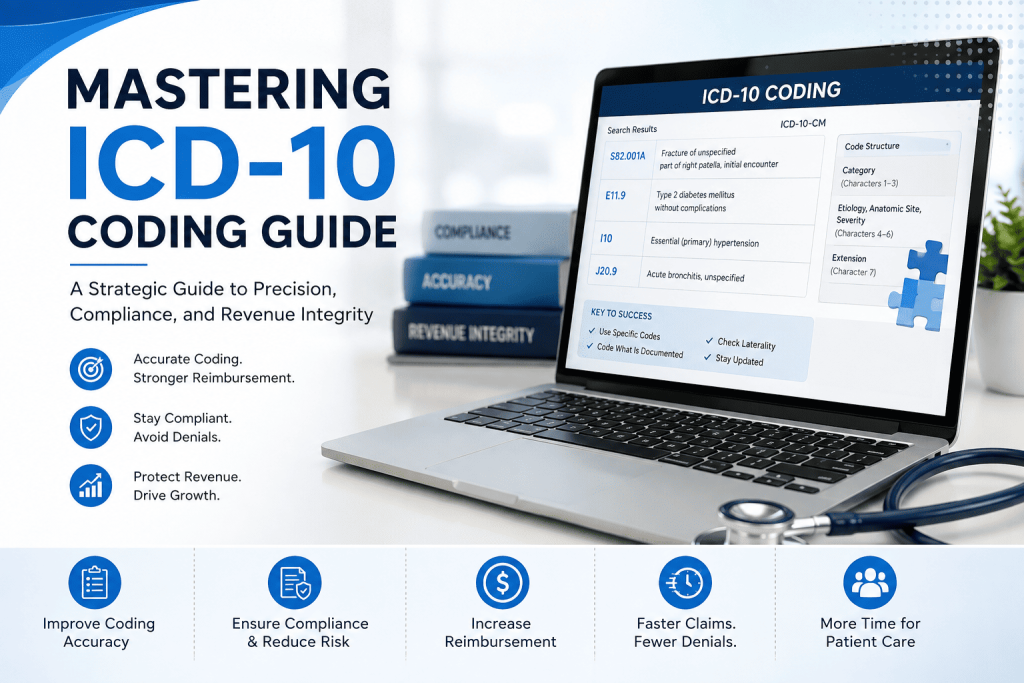
Running a healthcare practice involves much more than treating patients and managing appointments. Behind every patient visit, there is a series of administrative and financial activities that keep the organization running. Insurance verification, medical coding, claim submission, payment posting, denial management, and accounts receivable follow-up all play an important role in maintaining financial stability.
But managing all these activities consistently is not always easy.
Healthcare providers often deal with delayed reimbursements, increasing administrative costs, frequent claim denials, changing payer requirements, and staffing challenges. Even a small mistake during patient registration or medical coding can create problems later in the revenue cycle.
This is where a reliable Revenue Cycle Management (RCM) partner becomes valuable.
However, not every RCM company offers the same level of expertise, technology, transparency, or operational support. Choosing a company simply because it offers low pricing or promises faster reimbursements may not deliver the results your organization needs.
Selecting the Right RCM Company requires understanding your organization’s challenges, evaluating the provider’s capabilities, and finding a partner that can support your financial and operational goals over time.
Let’s explore what healthcare providers should consider before making this important decision.
What Is an RCM Company?
An RCM company manages some or all of the administrative and financial processes involved in collecting payments for healthcare services.
RCM stands for Revenue Cycle Management. It covers the complete financial journey of a patient account, starting when an appointment is scheduled and ending when the healthcare provider receives the appropriate payment and resolves any outstanding balance.
An RCM company may provide services such as:
- Patient registration and insurance eligibility verification
- Medical billing and claim submission
- Medical coding, including ICD-10, CPT, and HCPCS
- Payment posting and reconciliation
- Denial management and appeals
- Accounts receivable (A/R) follow-up
- Provider credentialing and insurance enrollment
- Financial reporting and revenue cycle analysis
Some companies offer only medical billing, while others provide comprehensive revenue cycle support.
Understanding this difference is important. If your organization is struggling with denied claims, aging A/R, and front-office inefficiencies, choosing a provider that only handles claim submission may not address the underlying problems.
Why Is Selecting the Right RCM Company Important?
Your revenue cycle directly affects your organization’s financial performance. When processes are not properly managed, payments can be delayed, claims can be rejected, and valuable staff time can be spent correcting avoidable errors.
Consider a example.
A patient visits a medical practice. During registration, the insurance information is entered incorrectly. The mistake goes unnoticed during eligibility verification. Later, the claim is submitted with inaccurate information and gets rejected.
Now someone must review the rejection, identify the problem, correct the information, resubmit the claim, and follow up with the payer.
One small error has created additional work for multiple people.
Imagine this happening across hundreds or thousands of patient accounts.
A capable RCM partner helps establish consistent processes across the revenue cycle, identify recurring problems, and improve how claims and payments are managed.
The right partnership can help your organization:
- Improve claim accuracy and submission processes.
- Identify avoidable denials and recurring billing errors.
- Maintain better control over outstanding accounts receivable.
- Reduce administrative pressure on internal employees.
- Improve visibility into collections and financial performance.
- Support compliance minded billing and coding practices.
- Scale administrative operations as patient volumes increase.
The objective is not simply to outsource billing. It is to build a more organized and financially sustainable revenue cycle.
10 Important Factors to Consider When Selecting the Right RCM Company
Choosing an RCM partner should be a thoughtful process. Instead of focusing on one selling point, evaluate the company’s overall ability to manage your revenue cycle.
Here are ten important factors to consider.
1. Look for Healthcare Industry Experience
Healthcare billing is not the same as general administrative work. It requires an understanding of insurance policies, medical terminology, coding requirements, payer guidelines, and reimbursement processes.
An experienced RCM company should understand how healthcare revenue cycles operate and how different administrative activities affect one another.
Ask potential providers:
- How long have you been working in healthcare RCM?
- What types of healthcare organizations do you support?
- Which billing and practice management systems do you work with?
- How do you keep your team updated on payer requirements?
Look beyond the number of years a company has been operating. Its practical experience handling the challenges your organization faces is more important.
2. Evaluate Specialty Specific Knowledge
Every medical specialty has different billing, documentation, coding, and reimbursement requirements.
For example, a cardiology practice may handle diagnostic tests, procedures, and complex documentation requirements. A mental health practice may have to manage different session types, authorization requirements, and payer-specific billing rules.
Similarly, urgent care centers often handle high patient volumes and require efficient claim processing, while orthopedic practices may deal with procedure coding and documentation complexities.
Before selecting an RCM company, ask whether its team understands your specialty.
Look for experience supporting areas such as:
- Cardiology
- Mental and behavioral health
- Gastroenterology
- Orthopedics
- Ophthalmology
- OB-GYN
- Urgent care
- Primary care
- Rural hospitals and healthcare facilities
A provider that understands your specialty is better positioned to recognize common billing challenges and build workflows around your organization’s requirements.
3. Understand the Complete Range of RCM Services
One of the biggest mistakes healthcare organizations make is choosing a company without understanding exactly what its service package includes.
Some providers focus primarily on medical billing, while others offer support across the complete revenue cycle.
Before signing an agreement, identify which activities you need to outsource and whether the company can manage them.
A comprehensive RCM service provider may offer:
Medical Billing: Accurate claim preparation, submission, payer follow-ups, and payment reconciliation.
Medical Coding: Appropriate assignment of ICD-10, CPT, and HCPCS codes based on clinical documentation and applicable coding guidelines.
Denial Management: Reviewing denied claims, identifying reasons, correcting errors, and managing appropriate appeals.
Accounts Receivable Management: Monitoring outstanding claims, prioritizing aging accounts, and following up on unpaid balances.
Eligibility Verification: Confirming insurance coverage, benefits, and applicable authorization requirements before services are provided.
Provider Credentialing and Enrollment: Managing payer applications, documentation, renewals, and enrollment follow-ups.
Medical Front Office Support: Assisting with scheduling, patient registration, insurance information, and other administrative activities.
The right combination depends on your existing operations. You may need complete RCM outsourcing, or you may only need additional support for specific functions.
4. Examine the Company’s Denial Management Process
Claim denials are one of the major challenges affecting healthcare revenue.
However, an effective RCM company should do more than resubmit denied claims. It should understand why claims are being denied and identify opportunities to prevent similar issues in the future.
For example, repeated eligibility denials may indicate problems with insurance verification. Coding denials may point toward documentation gaps, incorrect code selection, or payer-specific requirements.
Ask potential RCM partners:
- How do you categorize and analyze denials?
- How quickly are denied claims reviewed?
- How do you prioritize high value and aging accounts?
- Do you track recurring denial reasons?
- How do you communicate denial trends to clients?
A structured denial management process should include identifying the issue, determining its root cause, taking corrective action, and monitoring whether the same problem occurs again.
This approach helps organizations move from reactive claim correction toward more proactive revenue cycle management.
5. Check Technology and Automation Capabilities
Technology plays an increasingly important role in modern revenue cycle operations.
Manual processes can create unnecessary delays, increase repetitive work, and make it difficult to monitor large volumes of claims.
A technology enabled RCM company should use appropriate systems and automation to improve workflow efficiency without compromising accuracy or compliance.
Some capabilities worth evaluating include:
- Automated claim scrubbing and validation
- Insurance eligibility verification tools
- Workflow automation
- Denial tracking and analysis
- Payment reconciliation
- Performance dashboards
- Predictive cash flow analytics
- AI-assisted coding support with appropriate human oversight
However, do not select a provider simply because it uses artificial intelligence or automation.
Ask how the technology is actually used, what tasks it supports, how exceptions are reviewed, and whether qualified professionals oversee important billing and coding decisions.
The best approach combines technology with experienced people and well-defined processes.
6. Prioritize Data Security and HIPAA Compliance
RCM companies may access sensitive patient information, insurance records, medical documentation, and financial data.
That makes data protection a critical part of your selection process.
Before working with an RCM provider, understand its security policies and how it protects the information your organization shares.
Important questions include:
- Does the company have documented security policies?
- How is access to patient information controlled?
- Does it use appropriate data encryption and secure communication methods?
- How are employees trained on privacy and security requirements?
- What happens if a security incident occurs?
- Will the company sign an appropriate Business Associate Agreement (BAA), when required?
Under HIPAA, covered entities generally need appropriate written arrangements with business associates that handle protected health information on their behalf.
Do not rely only on verbal assurances. Request information about the company’s security controls, compliance procedures, and responsibilities before sharing patient data.
A trustworthy RCM partner should treat patient privacy and information security as essential operational responsibilities.
7. Demand Transparent Reporting and Performance Tracking
How will you know whether your RCM company is actually improving your revenue cycle?
The answer should be clear reporting.
A reliable provider should give you access to meaningful performance information instead of simply sending occasional updates about completed work.
Some important revenue cycle KPIs include:
Clean Claim Rate: Measures the percentage of claims submitted without errors that require correction or rework, according to the agreed definition.
Denial Rate: Shows the percentage of claims denied by payers and helps identify recurring issues.
Days in Accounts Receivable: Indicates how long it takes, on average, for outstanding receivables to be collected.
Net Collection Rate: Helps evaluate how effectively an organization collects the amount it is contractually entitled to receive.
A/R Aging: Shows how long outstanding balances have remained unpaid and helps prioritize follow-up activities.
Payment Posting Turnaround Time: Measures how quickly payments and adjustments are recorded after remittance information becomes available.
These metrics provide a clearer picture of operational performance.
However, the numbers alone are not enough. Ask your RCM provider to explain what the results mean, where problems are occurring, and what actions are being taken to improve performance.
Agree on KPI definitions, reporting frequency, baseline measurements, and realistic targets before the engagement begins.
8. Evaluate Communication and Customer Support
Even an experienced RCM company can become difficult to work with if communication is inconsistent.
Your internal team should know whom to contact when a claim issue arises, when a payer response is delayed, or when an operational concern needs attention.
Before choosing a provider, understand its communication structure.
- Will you have a dedicated point of contact?
- How frequently will performance updates be shared?
- How are urgent issues escalated?
- Are regular review meetings included?
- How quickly does the team respond to questions?
- Will you receive updates about significant payer or workflow issues?
Communication should not happen only when something goes wrong.
A strong RCM relationship involves regular discussions, performance reviews, issue tracking, and collaboration between the provider and your internal team.
9. Understand Pricing and Contract Terms
Cost is naturally an important consideration when selecting an RCM company. However, choosing the lowest-priced provider may not always be the most cost-effective decision.
A low service fee will not provide much value if the company lacks the expertise to handle complex claims, identify revenue leakage, or manage aging accounts.
RCM companies may use different pricing models, including:
- A percentage of collections
- A fixed monthly fee
- Per-claim pricing
- Per-provider pricing
- Customized pricing based on service scope
Before signing an agreement, ask for a clear explanation of the pricing structure.
Understand what is included in the quoted fee and whether additional charges apply to implementation, software, special projects, appeals, or other services.
Also review contract duration, termination clauses, transition responsibilities, data ownership, and service-level expectations.
The goal is to understand the total cost of the relationship and compare it with the operational value the provider is expected to deliver.
10. Choose a Partner That Can Scale With Your Organization
Your organization’s requirements today may not be the same as they will be next year.
You may add new providers, open additional locations, expand into another specialty, or experience an increase in patient volume.
Your RCM partner should be able to adapt as those changes happen.
Ask whether the company can:
- Support additional providers and locations.
- Adjust staffing according to workload.
- Handle different specialties and payer requirements.
- Expand services when operational needs change.
- Maintain consistent quality as volumes increase.
Scalability is not only about handling more claims. It is also about maintaining accuracy, communication, and accountability as your organization grows.
In-House RCM vs. Outsourced RCM: Which Is Better?
Many healthcare organizations wonder whether they should continue managing their revenue cycle internally or outsource some of the work.
There is no single answer for every practice. The right decision depends on staffing, claim volume, specialty requirements, operational costs, and internal expertise.
| Factor | In-House RCM | Outsourced RCM |
|---|---|---|
| Staffing | Requires internal hiring and management. | Provides access to an external team. |
| Training | Internal responsibility. | Provider manages its team’s training. |
| Technology | Organization manages its tools and systems. | Depends on the provider’s technology and integration. |
| Scalability | May require additional hiring. | Can offer flexible workforce support. |
| Management | Direct internal supervision. | Requires clear communication and performance oversight. |
| Cost Structure | Salaries, benefits, software, and operating expenses. | Service fees based on agreed pricing. |
Outsourcing does not necessarily mean replacing your existing billing department.
Many healthcare organizations use a hybrid approach in which internal employees manage important responsibilities while an external RCM company supports billing, coding, denial management, A/R follow-up, or other administrative activities.
This can provide additional capacity without requiring a complete operational change.
Warning Signs to Watch for When Choosing an RCM Company
While evaluating providers, pay attention to warning signs that could create problems after onboarding.
Be cautious if a company:
- Guarantees unrealistic reimbursement results.
- Cannot clearly explain its billing and denial management processes.
- Provides limited visibility into claims and collections.
- Has no structured quality assurance process.
- Avoids discussing data security and HIPAA responsibilities.
- Cannot explain how its performance will be measured.
- Offers no clear communication or escalation process.
- Does not understand your specialty or payer mix.
An RCM company should be able to explain not only what it promises to do but also how it plans to do it.
Ask for a clear scope of work, documented responsibilities, reporting expectations, and a practical onboarding plan.
How to Prepare Your Healthcare Organization Before Partnering With an RCM Company?
Selecting the right provider is only one part of building a successful RCM partnership. Your organization also needs to prepare for the transition.
Start by reviewing your existing revenue cycle operations.
Identify where problems occur most frequently. Are claims being denied because of inaccurate patient information? Is your team struggling with coding backlogs? Are outstanding accounts not receiving timely follow-ups? Are credentialing delays affecting provider reimbursements?
Once you understand these challenges, create a clear list of priorities.
Next, gather the information a potential provider may need, including:
- Current billing and coding workflows
- Provider and location details
- Payer mix and insurance information
- Existing billing and practice management systems
- Historical denial reports
- Accounts receivable aging reports
- Current revenue cycle KPIs
- Staffing responsibilities and workflow gaps
Discuss these requirements with the RCM company before implementation.
A structured onboarding process should establish service scope, system access, team responsibilities, communication channels, quality checks, escalation procedures, and reporting expectations.
It is also important to agree on baseline performance measures. Without a clear starting point, it becomes difficult to evaluate whether the partnership is delivering meaningful improvements.
Why GoSourceMD Is a Partner Worth Considering for Revenue Cycle Management?
Once you understand what to look for in an RCM provider, the next step is finding a company that combines healthcare expertise, dependable processes, technology, and operational flexibility.
GoSourceMD works with healthcare organizations to support revenue cycle operations through technology-driven and people-powered solutions.
Rather than looking at medical billing as an isolated activity, GoSourceMD focuses on connected processes that influence financial performance.
Its service capabilities include:
- Medical billing and claims management
- Medical coding and coding quality support
- Denial and accounts receivable management
- Provider credentialing and insurance enrollment
- Medical front-office support
- Out-of-network billing
- Revenue cycle reporting and analytics
- Workforce solutions
GoSourceMD also emphasizes automation, claim validation, eligibility verification, workflow optimization, and financial visibility.
What makes this approach relevant is the ability to align support with the organization’s actual operational needs. A healthcare practice may need assistance with its entire revenue cycle, while another may simply require additional support with coding, denials, or outstanding accounts.
The right service arrangement should reflect those differences.
For healthcare organizations looking to improve operational consistency, reduce administrative pressure, and gain better visibility into revenue cycle performance, GoSourceMD offers an opportunity to explore a more connected approach to revenue cycle management.
Learn more about the services at GoSourceMD.
Final Thoughts: Make Your RCM Partnership a Long-Term Investment
Selecting the right RCM company is an important decision that can influence your healthcare organization’s financial performance, administrative workload, and ability to grow.
The best provider is not necessarily the one offering the lowest price or making the biggest promises. It is the one that understands your challenges, communicates clearly, follows reliable processes, protects sensitive information, and provides measurable insight into your revenue cycle.
Take the time to evaluate experience, service capabilities, technology, reporting, compliance, and scalability before making a decision.
Most importantly, look for a partner that works with your organization rather than simply processing claims on its behalf.
A well-managed revenue cycle supports more than timely payments. It creates the operational foundation healthcare organizations need to remain financially healthy while continuing to focus on patient care.
Looking for a revenue cycle management partner that understands your operational challenges? Connect with GoSourceMD to discuss your healthcare organization’s RCM requirements and explore a solution aligned with your goals.
Visit www.gosourcemd.com to get started.
Frequently Asked Questions About Selecting the Right RCM Company
1. How do I select the right RCM company for my healthcare practice?
To select the right RCM company, evaluate its healthcare industry experience, specialty specific knowledge, range of services, technology, denial management process, data security practices, and reporting capabilities. Also consider its pricing structure, communication process, and ability to scale with your practice. Choose a provider that understands your operational challenges rather than focusing only on cost.
2. What services should I expect from a professional RCM company?
A professional RCM company may provide end-to-end revenue cycle services, including medical billing, medical coding, insurance eligibility verification, claim submission, payment posting, denial management, accounts receivable follow-up, provider credentialing, and financial reporting. The exact services depend on your healthcare organization’s requirements.
3. How much does it cost to outsource revenue cycle management?
The cost of outsourcing revenue cycle management depends on claim volume, specialty, practice size, service requirements, and the pricing model. Some RCM companies charge a percentage of collections, while others offer fixed monthly fees, per-claim pricing, or customized service packages. Always compare the complete service scope and potential additional charges before choosing a provider.
4. Is outsourcing RCM better than managing medical billing in-house?
Outsourcing RCM can provide access to experienced billing professionals, specialized resources, and additional operational capacity without requiring your organization to manage every function internally. In-house RCM offers more direct control but requires ongoing investment in staffing, training, and technology. A hybrid model can also work well when you want to retain internal control while outsourcing specific administrative tasks.
5. How can an RCM company help reduce medical billing denials?
An RCM company can help reduce avoidable claim denials by verifying insurance eligibility, reviewing patient information, checking coding accuracy, validating claims before submission, and monitoring payer requirements. It can also analyze recurring denial reasons, correct underlying workflow issues, and manage appropriate claim appeals.
6. What are the most important KPIs to evaluate an RCM company’s performance?
Important RCM performance indicators include clean claim rate, initial denial rate, days in accounts receivable, net collection rate, A/R aging, and payment posting turnaround time. These KPIs help healthcare organizations understand claim quality, reimbursement performance, and outstanding revenue. Review the metrics regularly with your RCM provider and agree on consistent definitions.
7. Why is specialty-specific experience important when choosing an RCM provider?
Different medical specialties have different coding requirements, documentation practices, payer policies, and reimbursement workflows. For example, cardiology, mental health, orthopedics, gastroenterology, and urgent care have different billing complexities. Choosing an RCM company familiar with your specialty can help ensure that its processes reflect your organization’s specific requirements.
8. How do I know if my healthcare practice needs an outsourced RCM partner?
Your practice may benefit from outsourced RCM support if you experience frequent claim denials, delayed reimbursements, increasing A/R balances, coding backlogs, staffing shortages, or inconsistent billing processes. If your internal team spends more time correcting billing issues than managing daily operations, it may be worth evaluating external RCM support.
9. What should I check before signing a contract with an RCM company?
Before signing an RCM contract, review the provider’s service scope, pricing structure, implementation timeline, performance expectations, reporting frequency, data security practices, HIPAA responsibilities, termination clauses, and communication process. Make sure responsibilities are clearly documented and that you understand how performance will be measured.
Ready to Strengthen Your Revenue Cycle?
Let’s discuss your healthcare organization’s revenue cycle challenges and explore the right support for your practice.