When you think about medical billing, the first thing that usually comes to mind is revenue getting paid for the hard work your practice does every day. But there is a silent partner in every transaction that is just as important as the dollar amount: security.
In the healthcare industry, a single data breach doesn’t just result in a lost claim; it can lead to massive fines, legal nightmares, and a total loss of patient trust.
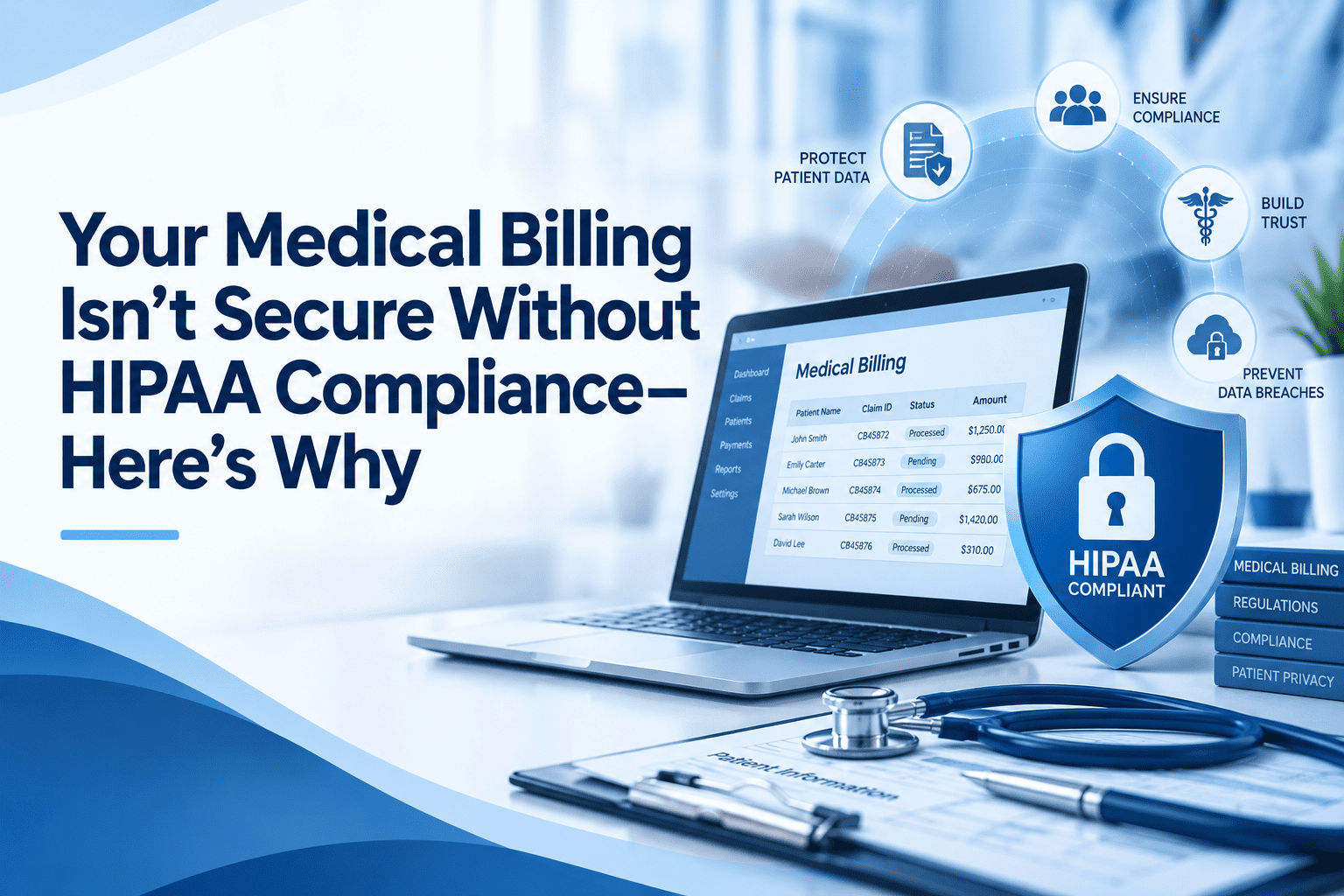
This is why HIPAA Compliance in Medical Billing is a topic that every practice owner, office manager, and biller needs to master.
HIPAA the Health Insurance Portability and Accountability Act can often feel like a massive wall of red tape. However, when you peel back the legal jargon, it’s really about one simple thing: protecting the patient.
In a world where medical data is more valuable to hackers than credit card numbers, your billing process needs to be more than just efficient it needs to be a fortress.
Let’s have a conversation about what it takes to keep your billing HIPAA compliant, the risks you might not be seeing, and how to protect your practice in the digital age.
What Exactly Is Protected Health Information (PHI)?
To stay compliant, we first have to define what we are protecting. In the billing, we deal with Protected Health Information (PHI).
This isn’t just a doctor’s note about a flu shot. PHI is any information that can link a specific individual to a medical service or payment.
In your billing department, PHI includes:
- Names, addresses, and birth dates.
- Social Security and Insurance ID numbers.
- Diagnosis codes (ICD-10) and Procedure codes (CPT).
- Payment records and bank details.
If a piece of paper or a digital file has a name and a code next to it, it’s PHI. And once you have PHI, you are legally responsible for its safety from the moment it’s collected until the moment it is destroyed.
The Three Pillars of HIPAA Compliance in Medical Billing
The government breaks HIPAA down into three main Rules. Think of these as the three different ways you need to secure your billing department.
1. Administrative Safeguards
This is often where the biggest risks lie. You can have the best software in the world, but if your staff isn’t trained, you have a hole in your security.
Administrative safeguards involve:
- Staff Training:
Everyone who touches a bill from the front desk to the remote biller must undergo regular HIPAA training. - The Minimum Necessary Rule:
This is a core HIPAA concept. It means staff should only access the minimum amount of information needed to do their job.
A biller needs the diagnosis code to file a claim, but they might not need to read the patient’s full family history. - Internal Audits:
You should regularly check who is accessing your records. If an employee who doesn’t handle billing is looking at billing files, that’s a red flag.
2. Physical Safeguards
This is about your physical environment.
- Workstation Security:
Are your billing screens visible to patients standing at the front desk? If so, you’re in violation. Screens should have privacy filters or be positioned away from public view. - Device Management:
If your billers use tablets or laptops, are those devices locked away when not in use? - Document Disposal:
A rejected claim printed on paper can’t just go in the blue recycling bin. It must be shredded. Using a professional shredding service is often the safest bet for a busy office.
3. Technical Safeguards
Since almost all billing is now electronic, this is where most of the focus goes today.
- Encryption:
When a claim is sent from your computer to the clearinghouse, it must be encrypted. This means if a hacker intercepts the data, it looks like gibberish to them. - Unique User IDs:
Never, ever share passwords. Each person needs their own login so that every action can be tracked back to a specific individual. - Automatic Logoffs:
If a biller walks away from their desk to take a phone call, the software should automatically log them out after a few minutes of inactivity.
The Minimum Necessary Standard
One of the most misunderstood parts of HIPAA Compliance in Medical Billing is the Minimum Necessary standard.
It essentially says that healthcare providers and their billing teams should only disclose or use the minimum amount of PHI necessary to accomplish a specific task.
For example, if you are appealing a denied claim for a broken arm, the insurance company needs to see the X-ray report and the surgical notes.
They do not need to see the patient’s entire history of dermatological visits or mental health records.
When you over-share information even if you think you’re just being thorough you are actually increasing your liability.
Learning how to redact or selectively share data is a hallmark of a professional, compliant billing team.
Why the Stakes Are Higher Than Ever?
You might wonder if the government actually checks up on small practices. The answer is yes, but the bigger threat is actually the Cyber Black Market.
A single medical record can sell for a high price on the dark web far more than a credit card number.
Why? Because medical records allow for medical identity theft, where someone can get expensive surgeries or drugs using another person’s identity.
If your practice is found to have a breach due to willful neglect (meaning you knew the rules but didn’t follow them), the fines can be astronomical.
For a small practice, a single mistake can be a business ending event.
Beyond the fines, the cost of notifying patients, providing credit monitoring, and fixing the security hole adds up quickly.
Common HIPAA Pitfalls in the Billing Cycle
Even the most careful offices can slip up. Here are the most common ways compliance is compromised:
- Unsecured Email:
Sending an EOB or a patient statement via standard Gmail or Outlook is a violation. Standard email is not secure.
You must use a HIPAA compliant email service or a secure patient portal. - Texting Patient Info:
It’s tempting to text a doctor a quick question about a code, but unless you are using a secure, encrypted messaging app, you are risking a breach. - The Post-it Note Error:
Writing a patient’s ID number and name on a sticky note and leaving it on a desk is one of the most common physical HIPAA violations. - Disposal of Electronics:
When you upgrade your office computers, you can’t just sell the old ones or donate them.
Hard drives must be wiped using Military grade software or physically destroyed to ensure no patient data remains.
Frequently Asked Questions
What is HIPAA compliance in medical billing?
It is the set of protocols and security measures healthcare providers and billing companies use to protect patient health information (PHI) during the billing, coding, and reimbursement process.
Who is responsible for HIPAA compliance in billing?
Everyone involved in the revenue cycle from the provider who documents the visit to the biller who submits the claim is responsible for protecting patient data.
Does medical billing software need to be HIPAA compliant?
Yes. Any software used to store or transmit billing data must have encryption, audit logs, and secure access controls to meet federal standards.
What are the consequences of a HIPAA violation in billing?
Consequences include heavy financial penalties from the OCR (Office for Civil Rights), potential lawsuits, and damage to the provider’s reputation.
Final Thoughts: Making Compliance Part of Your Culture
At the end of the day, HIPAA Compliance in Medical Billing shouldn’t be something you only think about once a year during a training session.
It should be a part of your daily culture.
It’s about creating a safe environment where patients feel secure and your practice is protected from the growing threats of the digital world.
When you prioritize privacy, you aren’t just avoiding fines; you are building a reputation as a professional, trustworthy, and high-quality healthcare provider.
Secure Your Practice with GoSourceMD
We know how much you have on your plate. Between seeing patients and managing a practice, worrying about the fine print of HIPAA security is the last thing you need.
You focus on the people; we’ll handle the encryption and the audit trails so you can finally get a good night’s rest.
That’s where GoSourceMD comes in.
At GoSourceMD, we treat your data as if it were our own.
We don’t just do billing we provide a secure, end-to-end revenue cycle solution that is built on a foundation of total HIPAA compliance.
Our team is rigorously trained, our systems are state-of-the-art, and our commitment to security is absolute.
When you partner with us, you get:
- Total Peace of Mind:
We follow the strictest federal guidelines to keep your data safe. - Bank-Level Security:
Your claims are transmitted through the highest levels of encryption. - Expert Oversight:
Our billers and coders are experts in both revenue maximization and data privacy.
Don’t let a compliance error threaten the practice you’ve worked so hard to build.
Let us handle the complexities of the billing process while keeping your data under lock and key.
Security is not a product, it’s a process. At GoSourceMD, we make HIPAA compliance the heartbeat of your billing cycle.
— The GoSourceMD Team
Is your billing process truly secure? Let’s make sure.
Visit www.GoSourcemd.com today and see how we can protect your practice and grow your revenue.