

Carelon Behavioral Health gives you 90 calendar days to file most claims. The clock starts on the date of service. For an inpatient stay, it starts on the discharge date instead. That window is shorter than many medical payers allow. And if a claim arrives late, Carelon will not pay it. So it helps to treat the deadline as a firm one.
Two numbers do most of the work here:
- First, initial claims get 90 days.
- Second, secondary claims get 60 days.
A secondary claim is one in which Carelon pays after the primary insurer. For those, the clock starts on the primary payer’s determination date, not the day you saw the patient.
Keep in mind that both numbers can shift.
The exact limit depends on the client, the health plan, and the state in which your practice bills! Some Anthem-sponsored and Medicaid plans give you longer. A few give you less.
For that reason, treat the figures below as Carelon’s standard default, not a promise about your own contract. In the end, the provider agreement you signed is the document that decides.
Before you lock a deadline into your workflow, check it against three sources:
- Your own provider agreement with Carelon
- Any state or plan-specific addendum for your market
- The member’s benefit plan documents
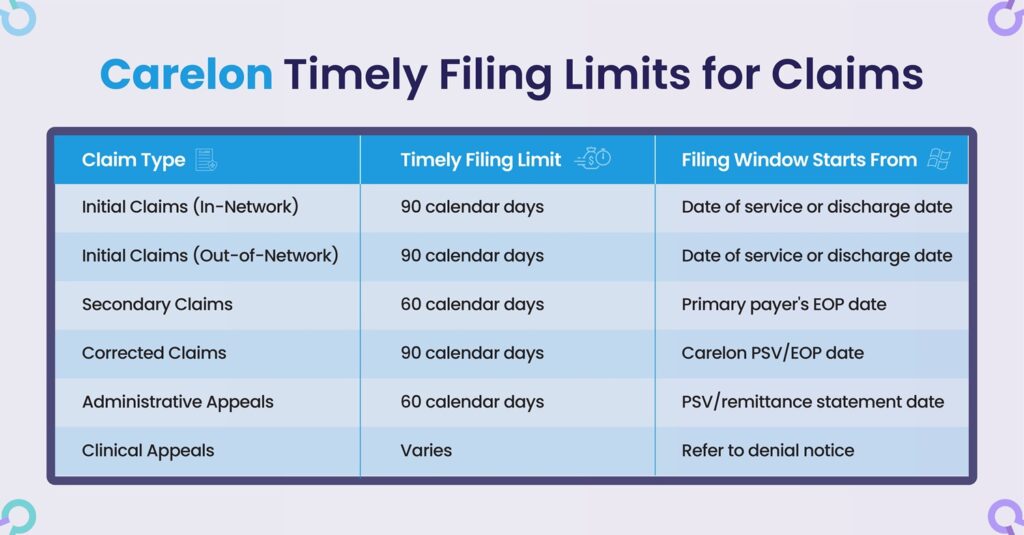
Carelon sets a submission window for both in-network and out-of-network providers. For initial claims, the window opens on the date of service or discharge. The default length is the same 90 days for both groups. Sometimes a deadline does differ. When it does, the cause is the plan type, your provider agreement, or your state’s rules. It is not your network status alone.
Participating (in-network) providers
For in-network providers, Carelon’s published default is 90 calendar days. That period runs from the date of service, or from the discharge date on inpatient care.
Still, it pays to file early rather than wait until the window closes. Suppose you send a claim within a week or two of the visit. You then have room to fix a rejection and resend it before the 90 days run out. Remember, there is no separate, longer clock for corrected claims. So the sooner the original version goes in, the more margin you keep.
Out-of-network (non-participating) providers
The same 90-day rule covers out-of-network providers who bill for authorized services. By itself, network status does not buy you a longer window. Both in-network and out-of-network claims start from the same default. Any extension would have to be written into your own agreement.
One issue trips up out-of-network billers more than the calendar does. That issue is authorization.
Carelon requires most services to be approved before they are delivered. The usual exceptions cover emergencies and certain Medicare cases. Now suppose you treat a member without prior authorization. The claim can be denied outright, whether or not it was on time. In other words, filing inside the window does not rescue a service that was never authorized.
Secondary claims (Carelon as secondary payer)
Sometimes Carelon pays second, after another insurer has already paid first. In that case, the filing window changes shape. It opens on the date of the primary payer’s EOP, which stands for explanation of payment. So it does not open on the date of service. It is also shorter, at 60 calendar days from that determination. Because the start date depends on the primary payer’s decision, hold onto the primary Explanation of Benefits. That document acts as your proof of when the 60-day clock began.
State rules can override this too. In Pennsylvania, for example, the Medicaid program counts third-party liability claims as 90 days from the primary EOB rather than 60 days. To stay safe, confirm the coordination-of-benefits deadline for your own plan. Do not assume the 60-day figure applies everywhere.
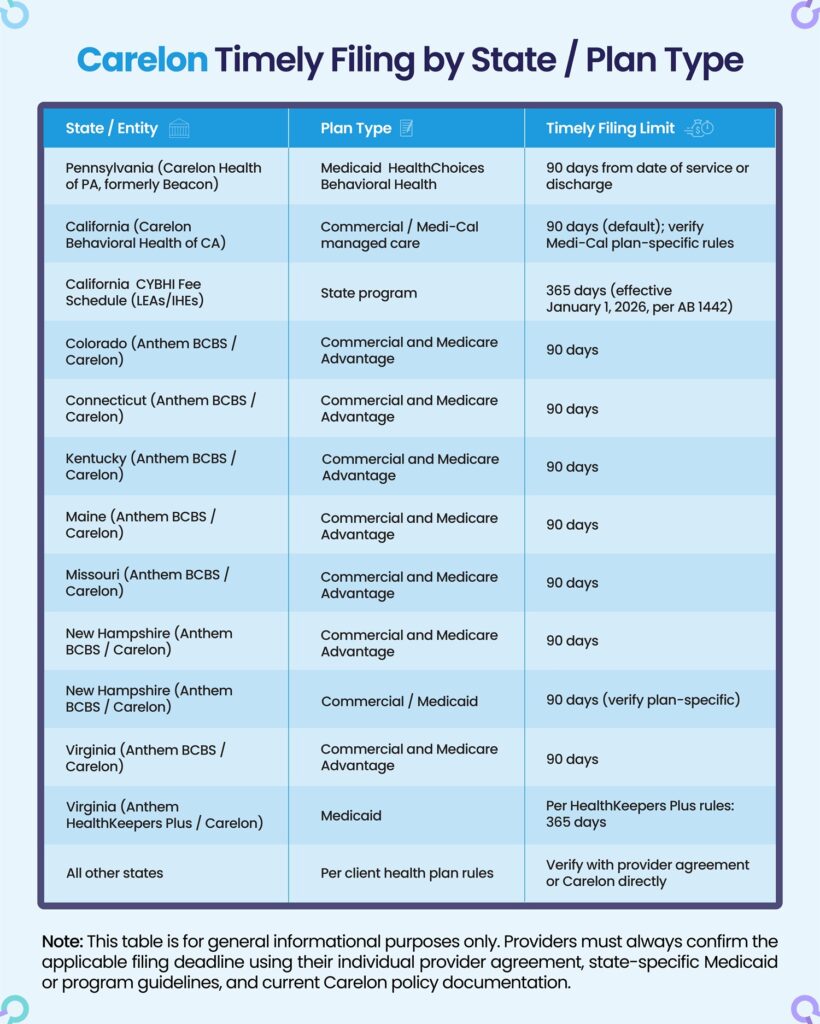
Carelon manages behavioral health benefits for many health-plan clients across the United States. That is the main reason the filing window moves around so much. The table below gives a general reference for the limits that come up most often by state and plan.
| State / entity | Plan type | Timely filing limit |
| Pennsylvania (Carelon Health of PA, formerly Beacon) | Medicaid, HealthChoices Behavioral Health | 90 days from date of service or discharge |
| California (Carelon Behavioral Health of CA) | Commercial / Medi-Cal managed care | 90 days (default); verify Medi-Cal plan-specific rules |
| California, CYBHI Fee Schedule (LEAs / IHEs) | State program | 365 days (effective Jan 1, 2026, per AB 1442) |
| Colorado (Anthem BCBS / Carelon) | Commercial and Medicare Advantage | 90 days |
| Connecticut (Anthem BCBS / Carelon) | Commercial and Medicare Advantage | 90 days |
| Kentucky (Anthem BCBS / Carelon) | Commercial and Medicare Advantage | 90 days |
| Maine (Anthem BCBS / Carelon) | Commercial and Medicare Advantage | 90 days |
| Missouri (Anthem BCBS / Carelon) | Commercial and Medicare Advantage | 90 days |
| New Hampshire (Anthem BCBS / Carelon) | Commercial and Medicare Advantage | 90 days |
| New Jersey (Wellpoint NJ / Carelon) | Commercial / Medicaid | 90 days (verify plan-specific) |
| Virginia (Anthem BCBS / Carelon) | Commercial and Medicare Advantage | 90 days |
| Virginia (Anthem HealthKeepers Plus / Carelon) | Medicaid | 365 days (per HealthKeepers Plus rules) |
| All other states | Per client health plan rules | Verify with provider agreement or Carelon directly |
Here is a 2026 change worth flagging for California school-linked providers. Under Assembly Bill 1442, the CYBHI Fee Schedule window grew from 180 days to 365 days. The change took effect on January 1, 2026, and it covers LEAs, IHEs, and affiliated providers. According to the Department of Health Care Services’ January 2026 program guidance, a claim more than 365 days past the date of service is no longer eligible for payment.
One more caution: Some Anthem-sponsored and Medicaid plans run longer than the 90-day default, and certain markets apply a 180-day limit. So do not treat a single row above as final. Always confirm each deadline against your provider agreement, the relevant state Medicaid or program guidance, and current Carelon policy.