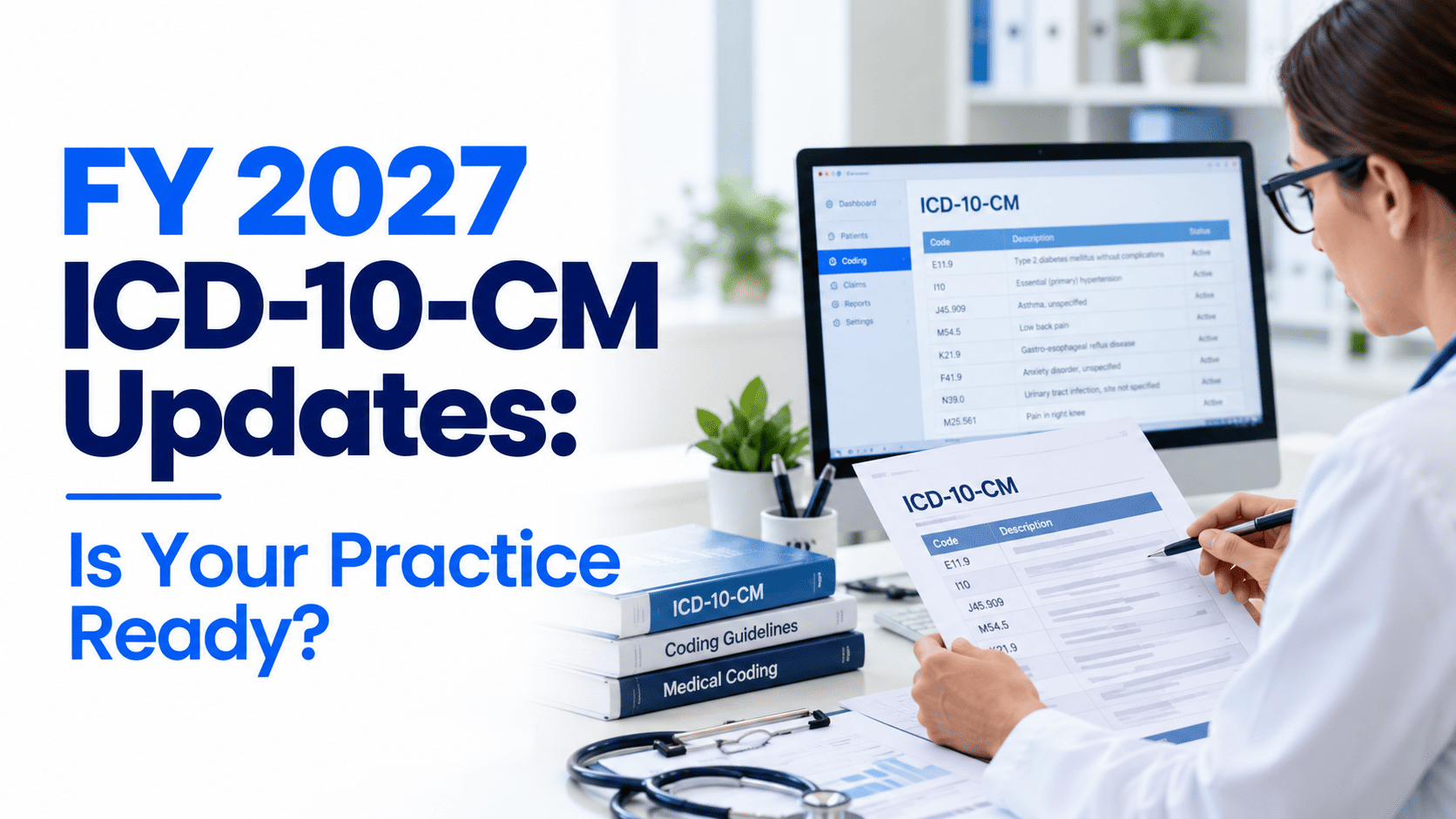
The new fiscal year brings updated diagnosis codes, revised coding guidance, and another reason for healthcare organizations to review their medical coding processes. If you manage a medical practice, work in medical billing, or oversee revenue cycle operations, these changes deserve your attention. The FY 2027 ICD-10-CM code updates took effect on October 1, 2026, and apply through September 30, 2027. Healthcare providers and coding teams should use the applicable FY 2027 diagnosis codes and official coding guidelines for encounters within this period. But updating a code list is only part of the process. Your team also needs to understand how the guidelines affect documentation, code selection, claim submission, and compliance.
What Are the FY 2027 ICD-10-CM Code Updates?
ICD-10-CM stands for the International Classification of Diseases, Tenth Revision, Clinical Modification. It is the standardized system used in the United States to classify diagnoses, symptoms, and reasons for healthcare encounters.
These codes help communicate a patient’s documented medical condition to insurers, healthcare organizations, and other parties involved in the billing process.
When a physician documents a patient’s condition, the medical coder uses the clinical documentation, the Alphabetic Index, the Tabular List, and the applicable coding guidelines to select the appropriate diagnosis code.
Annual updates may introduce new diagnosis codes, revise existing entries, remove codes that are no longer valid, and change coding instructions or guidance.
The FY 2027 code set applies to encounters from October 1, 2026, through September 30, 2027. Organizations should make sure their coding references, billing systems, and internal procedures reflect the correct fiscal-year version.
It is also important to understand that ICD-10-CM and ICD-10-PCS are different. ICD-10-CM covers diagnosis coding, while ICD-10-PCS is used for inpatient hospital procedure coding. This article focuses on ICD-10-CM diagnosis coding.
Review the official resources on the CMS ICD-10 codes page.
Why Do the FY 2027 ICD-10-CM Code Updates Matter?
You might be wondering, “If our team already knows ICD-10-CM, why do we need to review the guidelines every year?”
The answer is straightforward: accurate medical coding depends on using the right code, following the correct instructions, and supporting that code with appropriate documentation. Even a small mistake can create extra work later in the revenue cycle.
1. Accurate Coding Supports Cleaner Claims
A diagnosis code needs to match the provider’s documentation and applicable coding requirements. When a code is outdated, incomplete, or inconsistent with the medical record, a claim may require correction or additional review.
For example, imagine a physician documents a condition affecting a specific side of the body, but the claim uses a code that does not reflect the documented laterality. Depending on the code and payer requirements, the discrepancy may lead to a rejection, denial, or request for clarification.
2. Documentation Must Support Code Selection
The official FY 2027 guidelines emphasize complete and consistent medical record documentation. Coders should not guess, add unsupported details, or choose a more specific diagnosis simply because it appears more favorable for reimbursement.
When documentation is unclear, the appropriate next step may be to seek clarification from the responsible provider, following the organization’s established procedures.
3. Coding Accuracy Helps Reduce Rework
Think about what happens when a claim comes back for correction. Someone needs to review the denial or rejection, investigate the original documentation, correct the issue when appropriate, and resubmit or appeal the claim.
Consistent use of current codes and guidelines can help reduce avoidable errors, limit repetitive corrections, and keep claims moving through the billing process more efficiently.
4. Compliance Requires More Than Updating Software
A billing system may contain the latest code files, but that does not automatically mean every claim will be coded correctly. Your team still needs to understand coding conventions, review clinical documentation, follow sequencing instructions, and apply relevant chapter-specific guidance.
Technology can support accurate coding, but it cannot replace appropriate review and professional judgment.
Key Coding Principles to Review for FY 2027
The FY 2027 ICD-10-CM Official Guidelines for Coding and Reporting provide instructions for code selection and reporting across healthcare settings. Here are several important areas your team should revisit.
1. Use the Alphabetic Index and Tabular List Together
Finding a diagnosis in the Alphabetic Index is an important starting point, but it is not the end of the coding process. The coder should verify the proposed code in the Tabular List and review applicable instructions, including inclusion terms, exclusion notes, and any code-first or additional-code requirements.
Selecting a code based on its description alone may overlook instructions that affect whether it is appropriate or how it should be reported. A reliable coding process always includes verification against the official classification.
2. Pay Attention to Specificity and Laterality
Some diagnosis codes require details such as the affected body part, the right or left side, the stage of a condition, or the encounter character. When these details are required and documented, the code should reflect them appropriately.
Specificity must come from the medical record. Coders should not assume a missing detail or infer a diagnosis that the provider has not established.
3. Understand Combination Codes and Multiple Coding
Some codes describe more than one related aspect of a condition. These are commonly called combination codes. In other situations, more than one code may be required to describe a condition completely or to follow a specific coding instruction.
The FY 2027 guidelines include rules on combination codes, multiple coding, and instructions such as code first and use additional code. These rules can affect code selection and sequencing, so your team should review the instructions relevant to the condition being coded.
4. Review Signs, Symptoms, and Unspecified Codes
Not every encounter results in a confirmed diagnosis. Signs and symptoms may sometimes be reported when a definitive diagnosis has not been established, depending on the clinical circumstances and applicable coding rules.
An unspecified code may be appropriate when the record does not provide the necessary detail. It should not be used automatically when the documentation supports a more specific code. The goal is to select the most appropriate code supported by the record and permitted by the guidelines.
5. Review Guidelines for the Relevant Clinical Chapter
ICD-10-CM contains chapter-specific guidance for different categories of conditions, including infectious diseases, neoplasms, diabetes, mental and behavioral disorders, and diseases of the circulatory and respiratory systems.
These instructions can address situations that general coding rules do not fully explain. Coders should review the guidance relevant to the diagnosis rather than assume one general rule applies to every clinical situation.
Read the official FY 2027 ICD-10-CM Coding Guidelines (PDF) for the complete instructions.
How Can Coding Errors Affect Your Revenue Cycle?
Your revenue cycle involves multiple connected steps, from patient registration and insurance verification to coding, claim submission, payment posting, and denial management. An error in one step can create additional work in another.
If a diagnosis code does not match the supporting documentation or fails to meet an applicable coding requirement, a payer may request more information or deny the claim. Your team then needs to investigate the issue, determine the appropriate correction, and follow the payer’s process.
Not every coding error results in a denial, and not every denial is caused by coding. Eligibility issues, authorization requirements, missing information, payer policies, and other factors can also affect claim outcomes.
Still, coding accuracy is an important part of the overall process. Reviewing claims before submission, identifying recurring error patterns, and using current guidance can help organizations reduce avoidable problems.
A Practical Checklist for Implementing FY 2027 Updates
Now that the FY 2027 code set is in effect, what should your organization do? Use this checklist with your billing and coding team.
Step 1: Confirm that your references are current.
Verify that coding staff and billing systems are using the applicable FY 2027 ICD-10-CM code files. Do not assume an automatically updated system has been configured correctly.
Step 2: Review relevant code changes.
Use the official FY 2027 code tables, addenda, and CMS resources to identify changes relevant to your specialties and patient population.
Step 3: Update internal coding procedures.
Review coding instructions, reference documents, internal checklists, and claim editing rules. Make sure your procedures reflect the applicable code set and official guidelines.
Step 4: Train your team.
Share relevant changes with physicians, documentation staff, coders, and billing personnel. Focus on practical examples and the types of errors your organization is most likely to encounter.
Step 5: Review claims before submission.
Use appropriate coding edits and quality checks to identify missing information, unsupported code selection, inconsistent details, and other potential problems.
Step 6: Monitor denials and recurring errors.
Track denial reasons, coding corrections, documentation related issues, and repeated claim rework. Look for patterns that point to a training need or process problem.
Step 7: Revisit the process regularly.
Periodic reviews help your organization identify new problems, reinforce correct practices, and keep the revenue cycle operating consistently.
How GoSourceMD Can Help Healthcare Organizations?
Keeping up with coding requirements while managing daily patient care and billing responsibilities can put pressure on an already busy team. A structured medical coding and billing process can make a difference.
At GoSourceMD, we support healthcare organizations with medical coding, medical billing, claim submission, denial management, and revenue cycle services. Our focus is on helping practices improve coding accuracy, identify avoidable billing issues, and manage the administrative work involved in getting claims processed.
Here is how that support can fit into your workflow:
- Medical coding support: Review diagnosis coding against available clinical documentation and applicable coding requirements.
- Claim review and submission: Help identify potential claim issues before submission and support a more consistent billing workflow.
- Denial management: Review denial reasons, support appropriate corrections and appeals, and identify recurring issues.
- Compliance-focused processes: Help teams keep their coding and billing workflows aligned with current requirements.
- Revenue cycle visibility: Use reporting and performance monitoring to understand where claims are delayed and where improvements may be needed.
The right approach depends on your practice’s specialty, claim volume, internal staffing, and existing systems. The goal is to build a process that supports accurate claims while reducing unnecessary administrative work.
If your team is reviewing its FY 2027 coding workflow, explore GoSourceMD’s medical coding services to learn more.
Final Thoughts
The FY 2027 ICD-10-CM code updates are more than an annual administrative task. They are an opportunity to review how your organization documents diagnoses, selects codes, checks claims, and manages recurring billing issues.
Start with the official guidelines, confirm that your code references are current, and focus your training on the changes most relevant to your practice. Then monitor your claims to see whether the updated process is reducing avoidable errors and rework.
Accurate coding begins with clear documentation and continues through every step of the claim process. With the right procedures, ongoing education, and appropriate support, your organization can approach the FY 2027 coding year with greater consistency and confidence.
Need Support With Medical Coding or Billing?
GoSourceMD helps healthcare organizations manage medical coding, billing, and revenue cycle workflows. Connect with our team to discuss how we can support your practice.
Official reference:
FY 2027 ICD-10-CM Official Guidelines for Coding and Reporting — CMS.
Frequently Asked Questions About FY 2027 ICD-10-CM Code Updates
1. What are the FY 2027 ICD-10-CM code updates?
The FY 2027 ICD-10-CM code updates are annual changes to the U.S. diagnosis coding system. They may include new, revised, and deleted codes, along with updated coding guidance. The updated code set applies from October 1, 2026, through September 30, 2027. Healthcare organizations should review the official code files and guidelines to ensure they use the correct codes.
2. How can the FY 2027 ICD-10-CM code updates affect medical billing?
Using outdated or incorrect diagnosis codes can contribute to claim rejections, denials, payment delays, and additional administrative work. Reviewing the updated code set, validating clinical documentation, and checking claims before submission can help healthcare organizations reduce avoidable coding related issues.
3. How can healthcare providers prepare for the FY 2027 ICD-10-CM code updates?
Healthcare providers can prepare by updating coding references and billing systems, reviewing relevant code changes, training coding and billing staff, and confirming that diagnosis codes are supported by medical documentation. Practices should also monitor denials and recurring coding errors to identify areas for improvement.
4. Can outdated ICD-10-CM codes lead to claim denials?
Yes. Outdated or invalid codes can cause claim processing problems, depending on the circumstances and payer requirements. Unsupported diagnoses, missing specificity, or inconsistent documentation may also contribute to denials. Reviewing claims against current coding requirements can help identify potential problems before submission.
5. How can medical coding services help reduce coding errors and denials?
Medical coding services can help healthcare organizations review clinical documentation, assign appropriate diagnosis codes, identify potential coding inconsistencies, and support compliant workflows. GoSourceMD provides medical coding and revenue cycle support to help practices improve coding accuracy and identify recurring billing issues.
6. Should a healthcare practice outsource medical coding after the FY 2027 updates?
Outsourcing may be worth considering if your practice is experiencing coding backlogs, frequent coding-related denials, staffing shortages, or difficulty keeping up with coding requirements. The decision depends on your claim volume, specialty, internal expertise, and budget. GoSourceMD offers medical coding services that practices can consider when evaluating their operational needs.
7. How does GoSourceMD support healthcare organizations with ICD-10-CM coding?
GoSourceMD provides medical coding services to support appropriate code assignment, documentation review, coding audits, and denial prevention. Its broader revenue cycle services also include medical billing, claim submission, denial management, and follow-up. These services can help healthcare organizations address coding-related workflow challenges.
8. How can I tell whether my medical practice needs coding and billing support?
Review your claim denial reasons, coding correction rates, outstanding accounts receivable, billing workload, and recurring documentation issues. If these problems are consuming staff time or delaying reimbursement, reviewing your coding and billing workflow may help identify opportunities for improvement. Contact GoSourceMD to discuss your practice’s medical coding and revenue cycle support needs.