Healthcare organizations are under pressure to do more with less. Patient volumes are changing, payer requirements continue to evolve, administrative workloads are growing, and revenue cycle teams have to manage a large amount of information every day.
At the same time, providers cannot afford unnecessary billing delays, avoidable claim denials, or revenue leakage.
This is where healthcare automation can make a meaningful difference.
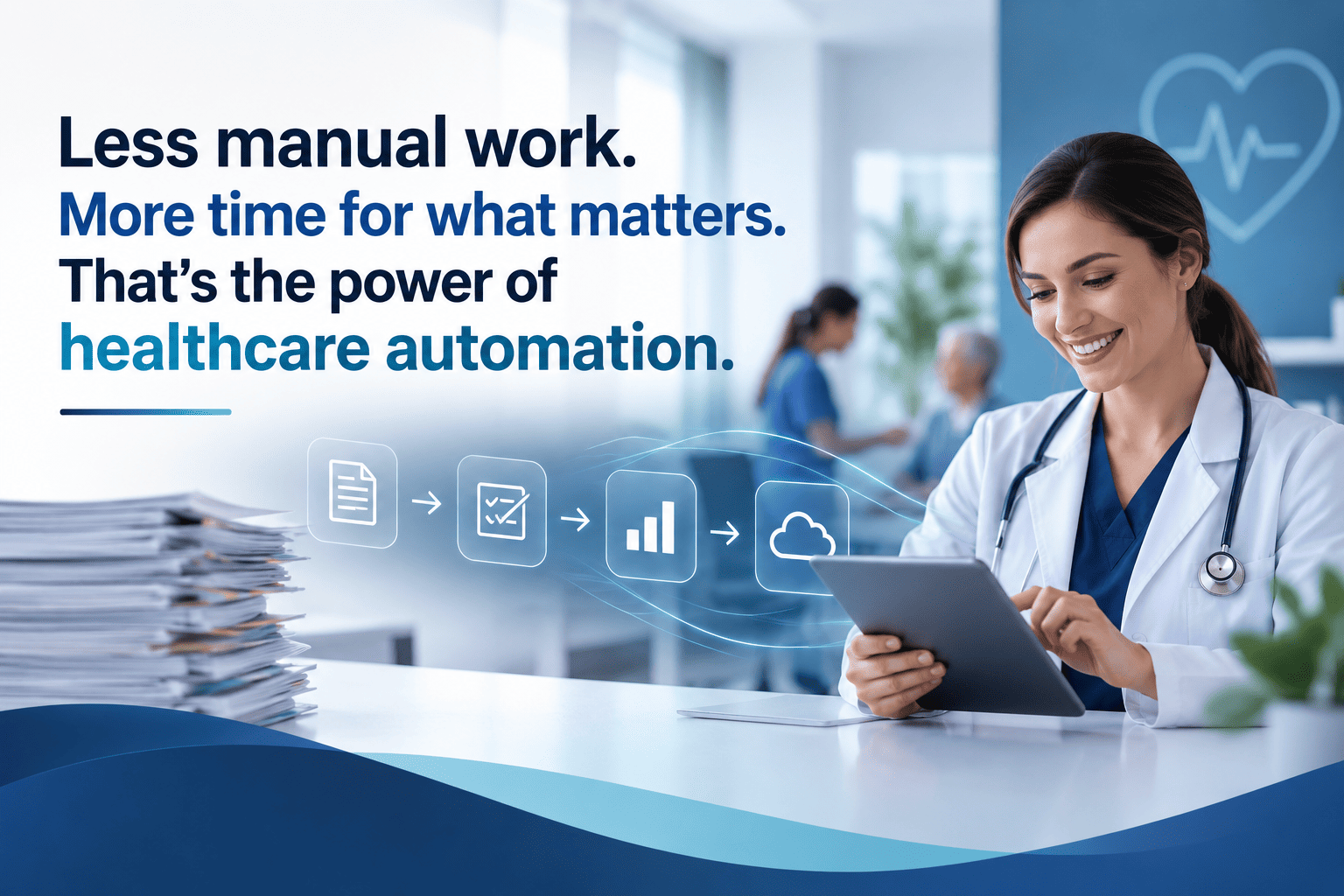
Healthcare automation benefits go beyond simply reducing manual work. When automation is applied to the right parts of the healthcare revenue cycle, it can help teams improve data accuracy, identify issues earlier, speed up repetitive processes, and gain better visibility into financial performance.
But there is an important point to remember: automation does not mean removing people from the process.
For healthcare organizations, the most useful approach is often a combination of technology, automation, experienced RCM professionals, and continuous monitoring.
GoSourceMD follows this technology-driven, people-powered approach to Revenue Cycle Management (RCM), combining automation and intelligent processing with healthcare billing, coding, denial management, A/R, and workforce expertise.
So, what exactly can automation do for your revenue cycle? Let’s take a closer look.
What Is Healthcare Automation?
Healthcare automation refers to using technology to perform repetitive, rule-based, data-intensive, or time-sensitive tasks with less manual intervention.
In a revenue cycle environment, this can include processes such as:
- Insurance eligibility verification
- Claim scrubbing
- Charge and data validation
- Claim routing
- Coding audits
- Payment posting workflows
- Denial identification
- A/R prioritization
- Revenue cycle reporting
- KPI monitoring
- Workflow notifications
The goal is not to automate every decision.
Instead, the goal is to let technology handle repetitive work and identify patterns while experienced healthcare professionals focus on tasks that require judgment, communication, problem-solving, and payer knowledge.
For example, an automated claim-scrubbing process can identify missing information or potential billing errors before a claim is submitted. A billing specialist can then review issues that require human attention.
That combination can create a more efficient revenue cycle.
Why Is Healthcare Automation Important for RCM?
Revenue Cycle Management begins long before a payment reaches a healthcare organization.
A patient’s information needs to be captured correctly. Insurance eligibility needs to be verified. Services need to be documented and coded accurately. Claims need to be submitted according to payer requirements. Payments need to be posted correctly, and unpaid or denied claims need timely follow-up.
A small issue at one stage can create additional work later.
For example:
Automation can help identify certain problems earlier in this process.
GoSourceMD’s RCM approach uses technology capabilities such as automated claim scrubbing, eligibility verification, workflow automation, analytics, denial trend modeling, and AI-assisted coding processes to support revenue cycle operations.
10 Healthcare Automation Benefits for Your Revenue Cycle
1. Reduce Repetitive Administrative Work
One of the biggest healthcare automation benefits is reducing the amount of repetitive work performed manually.
Revenue cycle teams may spend significant time checking information, reviewing claims, moving data between systems, monitoring claim status, and preparing reports.
When appropriate tasks are automated, teams can spend less time on repetitive activities and more time on exceptions and higher-value work.
For example, automation can help with:
- Eligibility checks
- Claim validation
- Data matching
- Worklist creation
- Status monitoring
- Reporting
- Routine follow up workflows
This does not eliminate the need for an experienced RCM team. Instead, it gives that team more time to work on complex issues.
2. Improve Claim Accuracy
A clean claim starts with accurate information.
Errors in patient demographics, insurance information, coding, modifiers, documentation, or payer-specific requirements can create claim rejections or denials.
Automated claim-scrubbing technology can review claims against defined rules before submission and flag potential issues.
This gives the billing team an opportunity to correct problems before the claim reaches the payer.
GoSourceMD incorporates automated claim scrubbing and billing workflows to support cleaner claim submission and reduce preventable billing issues.
That can reduce unnecessary rework and help keep claims moving.
3. Support Faster Reimbursement
Healthcare providers provide services today, but reimbursement may happen much later.
The longer a claim remains unresolved, the longer the organization has to wait for payment.
Automation can help accelerate different stages of the revenue cycle by reducing manual processing, identifying exceptions, and helping teams prioritize work.
For example, automated workflows can help identify claims that require attention instead of requiring staff to manually search through large volumes of accounts.
Faster processing does not guarantee faster payment for every claim, but a more organized and proactive revenue cycle can help reduce avoidable delays.
GoSourceMD’s RCM services focus on accurate claim submission, denial management, payment processing, and A/R follow-up to help keep reimbursement moving.
4. Help Reduce Preventable Denials
Denials are not always caused by one major mistake.
Sometimes, the problem is something as simple as incorrect patient information, eligibility issues, missing documentation, coding errors, authorization problems, or payer-specific requirements.
Automation can help identify recurring patterns.
For example, if a particular payer repeatedly rejects claims for the same reason, analytics can help bring that pattern to the attention of the RCM team.
The team can then investigate the root cause and make changes to the process.
This is important because denial management should not only be about fixing denied claims.
It should also be about asking:
GoSourceMD’s RCM approach includes denial management, denial trend analysis, and root cause focused processes designed to help organizations address recurring issues.
5. Improve Insurance Eligibility Verification
Eligibility problems can create billing issues before a claim is even submitted.
If coverage information is incorrect or outdated, the organization may discover the problem only after providing services.
Automated eligibility verification can help teams check coverage information earlier in the process.
This can help identify issues such as:
- Inactive coverage
- Incorrect insurance information
- Benefit limitations
- Coverage changes
- Patient responsibility information
GoSourceMD includes patient and insurance verification as an important part of its medical billing workflow.
The earlier an issue is identified, the more opportunity the practice has to address it.
6. Strengthen Medical Coding Workflows
Medical coding is another area where technology can support RCM teams.
Coders need to review documentation and apply the appropriate coding guidelines based on the services and diagnoses documented.
Technology can assist by identifying potential coding inconsistencies, missing information, or claims that require additional review.
However, automation should support not replace professional coding judgment.
GoSourceMD’s medical coding services combine certified coding expertise with technology such as AI-driven audits and claim-scrubbing capabilities to support coding accuracy, compliance, and denial prevention.
This human plus technology model can be especially useful when organizations manage high claim volumes or multiple specialties.
7. Improve A/R Management
Accounts Receivable is one of the areas where visibility matters.
A practice may have thousands of outstanding claims or balances. Without organized prioritization, teams can spend valuable time manually reviewing accounts without knowing which ones require immediate attention.
Automation and analytics can help organize A/R work based on factors such as:
- Aging
- Claim status
- Payer
- Balance
- Denial reason
- Follow-up history
- Payment trends
This helps RCM teams focus their efforts where they may have the greatest operational impact.
GoSourceMD provides A/R follow-up and denial management as part of its broader medical billing and RCM services.
8. Give Healthcare Leaders Better Financial Visibility
Imagine having to wait until the end of the month to understand what is happening with your revenue cycle.
That makes it difficult to respond quickly.
Automation combined with reporting and analytics can provide more timely visibility into important RCM metrics.
Healthcare leaders may monitor metrics such as:
- Clean claim rate
- Denial rate
- Days in A/R
- Aging A/R
- Net collection rate
- Payment trends
- Claim volume
- Reimbursement performance
GoSourceMD highlights KPI dashboards, financial visibility, analytics, and revenue cycle reporting as part of its technology-driven RCM approach.
Better visibility helps leaders move from What happened? to What is happening, and where should we look next?
9. Help Teams Scale Without Adding the Same Amount of Manual Work
As a healthcare organization grows, its revenue cycle grows with it.
More providers can mean:
If every process depends entirely on manual work, growth can increase administrative pressure.
Automation can help organizations handle higher transaction volumes more efficiently.
This does not necessarily mean replacing staff.
Instead, technology can help existing teams manage more work by reducing repetitive tasks and organizing priorities.
GoSourceMD also offers workforce solutions that can work alongside existing healthcare teams, allowing organizations to supplement internal operations where needed.
10. Create a More Proactive Revenue Cycle
Traditional billing can sometimes feel reactive.
A claim is denied, so someone works on the denial.
A payment is delayed, so someone follows up.
A/R increases, so the team investigates.
Automation and analytics can help shift the approach toward prevention.
Instead of simply asking:
the organization can ask:
That shift is one of the most valuable healthcare automation benefits.
It moves the revenue cycle from simply processing transactions to continuously improving the process.
Healthcare Automation Does Not Replace the RCM Team
This is an important distinction.
Automation is powerful, but healthcare revenue cycle management involves decisions that may require experience, context, payer knowledge, communication, and judgment.
For example, technology may identify a potential denial.
But an experienced RCM professional may need to:
- Review the claim
- Understand the denial reason
- Check documentation
- Communicate with the payer
- Correct the claim
- Prepare an appeal
- Determine whether the issue is part of a larger trend
That is why a technology driven and people-powered RCM model can be valuable.
GoSourceMD combines technology with healthcare billing, coding, denial management, A/R, analytics, and experienced professionals rather than treating automation as a standalone solution.
Where Should a Healthcare Organization Start With Automation?
You do not have to automate everything at once.
A better approach is to identify where your revenue cycle team is spending the most time and where repetitive errors are occurring.
Start by asking:
Where are claims being delayed?
Look at the time between charge entry, claim submission, payer response, and payment.
What are your most common denial reasons?
Repeated denial patterns may point to a process that needs improvement.
Where is your team doing repetitive manual work?
Look for tasks that follow predictable rules and consume significant staff time.
How quickly can you identify A/R problems?
If leaders cannot easily see aging accounts, denial trends, or reimbursement performance, reporting and analytics may need attention.
Are your front-end processes creating downstream problems?
Eligibility verification, patient information, authorization, and documentation can all affect what happens later in the revenue cycle.
Once these areas are understood, automation can be introduced where it makes the most practical sense.
How GoSourceMD Uses Automation in Revenue Cycle Management?
At GoSourceMD, healthcare automation is part of a broader RCM strategy.
The goal is not simply to introduce another technology platform. The focus is on connecting technology with the day to day work required to keep the revenue cycle moving.
GoSourceMD’s technology capabilities include:
Automated Claim Scrubbing: Helps identify potential claim issues before submission.
Eligibility Verification: Supports earlier identification of insurance and coverage issues.
Workflow Automation: Helps streamline repetitive revenue cycle processes.
Denial Trend Modeling: Helps identify recurring denial patterns.
AI-Assisted Coding: Supports coding review and accuracy.
Predictive Cash Flow Analytics: Provides additional insight into revenue trends.
KPI Dashboards: Helps healthcare organizations monitor revenue cycle performance.
These capabilities work alongside services such as medical billing, medical coding, denial management, A/R follow-up, payment posting, and front office support.
That combination matters because automation works best when it is connected to an actual process.
Automation Should Make the Revenue Cycle Smarter
The conversation around healthcare automation often focuses on technology.
But the more important question is:
If your team is spending too much time on repetitive billing tasks, automation may help.
If claims are frequently rejected, automated claim checks may help identify issues earlier.
If denials continue to repeat, analytics may help uncover patterns.
If A/R is difficult to monitor, better reporting and workflow automation may give your team more visibility.
And if your internal team needs additional support, combining automation with experienced RCM professionals can create a more complete solution.
The real Healthcare Automation Benefits come from using technology thoughtfully not simply using technology because it is available.
For healthcare organizations, the goal should be a revenue cycle that is more accurate, more visible, more proactive, and easier to manage.
That is where automation can become more than a technology investment. It can become part of a smarter revenue cycle strategy.
Frequently Asked Questions About Healthcare Automation Benefits
What are the main healthcare automation benefits?
The main benefits include reducing repetitive administrative work, improving claim accuracy, supporting faster processing, identifying denial patterns, improving eligibility verification, strengthening A/R management, and providing better financial visibility.
Can healthcare automation reduce claim denials?
Automation can help identify certain errors before claims are submitted and can also help organizations analyze recurring denial patterns. However, reducing denials depends on the quality of the underlying processes, coding, documentation, payer requirements, and follow-up.
How does automation help Revenue Cycle Management?
Automation can support multiple stages of RCM, including eligibility verification, claim scrubbing, coding review, claim workflows, denial analysis, A/R prioritization, and reporting.
Is healthcare automation suitable for small medical practices?
Yes. Small practices can also benefit from automation, particularly when administrative workloads are consuming staff time. The appropriate solution depends on the practice’s size, specialty, claim volume, existing technology, and revenue cycle challenges.
What should healthcare organizations automate first?
Organizations should generally begin by identifying repetitive, time-consuming processes that have clear rules and measurable outcomes. Eligibility verification, claim validation, reporting, and workflow management can be areas to evaluate.
How can GoSourceMD help with healthcare automation?
GoSourceMD combines technology driven automation with Revenue Cycle Management services, including medical billing, medical coding, denial management, A/R follow-up, eligibility verification, analytics, and workforce support. Its technology capabilities include automated claim scrubbing, workflow automation, denial trend analysis, KPI dashboards, and AI-assisted coding.
Ready to Make Your Revenue Cycle More Efficient?
Healthcare automation is most valuable when it is connected to the right people, processes, and goals.
If your organization is dealing with repetitive billing work, preventable denials, A/R challenges, or limited revenue visibility, GoSourceMD can help evaluate your current revenue cycle and identify opportunities for improvement.
Explore GoSourceMD’s Revenue Cycle Management Services for technology driven, people powered support across billing, coding, claims, denials, A/R, and financial reporting.